
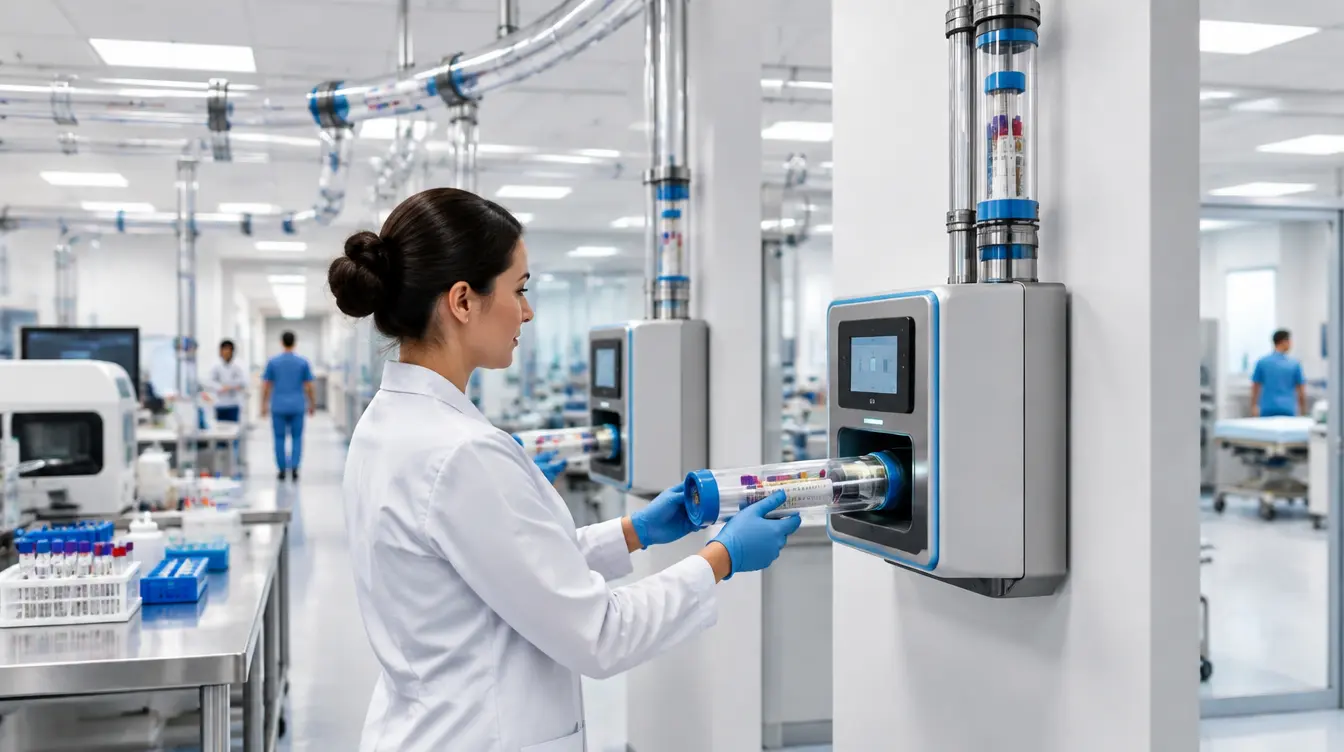
Transport of medications, blood units, specimens, reports and other departments dependent on time delays are also common practice. Manual transportation can induce delay and add an additional burden on staff, in large or busy hospitals. A pneumatic tube system is an efficient, automated intra-hospital transportation solution, whereby sealed carriers are transferred via a system of pipes at high speed, designed as a pneumatic tube system for hospitals, facilitating speedy movement of materials between laboratories, pharmacy, wards, operating theatre and numerous other areas.
Pneumatic tube system, known as a tube system, is an automated system that propels specially designed capsules through a network of tubes by compressed air or by partial vacuum. In a hospital, work stations, laboratory stations, pharmacies, and other installations send items such as medicines, samples, and documents between departments by means of the system.
Items approved by the hospital can be placed into a capsule, and the capsule can be sent from one station to another with the use of sending and receiving stations, tube networks, carriers, blowers, and electronic controls. That’s why the hospital pneumatic tube system is used and preferred by major healthcare centres.
The work flow of a pneumatic tube transport system is very simple:
This simplicity process allows us to know how the pneumatic tube system works and also aids us in accelerating inner material movement which is possible with Airox Technologies.
Hospitals manage critical materials that require quick transmission where moving lines are important. Pneumatic tube system for hospitals introduces automated internal delivery of these materials, eliminating duplication of transportation by your staff across various departments.
Key pneumatic tube system benefits include more rapid movement, linear flow, lessen worker fatigue and increasing support to transport items such as medicines, reports and samples.
A hospital pneumatic tube system allows swiftly transporting safe and approved items through laboratories, pharmacies, emergency rooms, ICUs, operating rooms, and other facilities and departments that are connected. Carriers run straight through the tube system, eliminating the need for personnel to physically carry things from one place to another.
This swift ensure fast hospital transport conveyance method which is possible by trusting Airox Technologies which can help move specimens, medications, reports, and paperwork on time while helping to keep internal operation more systematic.
A pneumatic transport system frees your staff or internal courier from the task of transporting relatively routine materials from hospital department to hospital department time and time again.
Automated hospital transport movement of approved objects via tube system means even very routine transports can be minimized, reducing the time spent moving the materials so that your people can focus more attention on patient care, clinical duties, and other tasks that demand their focus.
Stream lined internal transport automates the movement of materials within the hospital. For example, automatic routing between departments via a connected system of facilities can give staff additional control. By sending approved carriers through a pneumatic tube system straight to their destination, administrators can cut down on avoidable movements, keep delay occurring during routine transport to a minimum and ensure a steady stream of medicines, specimens, paperwork and other materials.
A pneumatic carrier system involves special carriers, destination routing, sensors, and remote monitoring controls to facilitate internal movement. Personnel indicate the destination, and system controls guide the carrier through the correct tube path.
Sensors monitor the movement, and a monitoring system assists the hospital in overseeing the flow of activity at different junction points in the system. These are parts of a hospital transport system that helps you to enhance your internal processes.
The following table talks about the technical specification of the pneumatic tube system.
| Parameter | Specification |
|---|---|
| System Type | Single Line / Multi Line / Fully Automated |
| Tube Diameter | Up to 160 mm |
| Carrier Capacity | Up to 5 kg |
| Transport Speed | Up to 8 m/s |
| Number of Stations | As per the client's request |
| Routing Configuration | As per the client's request |
| Control Interface | Touchscreen / PLC-Based |
| Tube Material | PVC / Aluminum / Stainless Steel |
| Monitoring System | Real-Time Tracking Available |
| Communication Protocol | Ethernet / Network-Based |
| Power Supply | As per client's request |
| Backup Power | Optional UPS Integration |
| Installation Layout | Customized as per client request |
| Expansion Capability | Available for Future Requirements |
Within hospitals, the Pneumatic tube system Components system may involve transportation of the following suitable items over and above transport of other suitable items between related hospitals and hospitals:
This hospital pneumatic transport method can obtain the internal transfer and reduce the general manual operation.
Choosing the right system for hospital layout, transport requirements and plans are all important for that consider these pneumatic tube system features:
Prior to the installation of any system, hospitals need to look at future departments, other stations and evolving transport demands. An scalable pneumatic tube system allows the ability to grow with the hospital or adapt to changes in its workflows. Planning for routes, station capacity and infrastructure beforehand ensures building expansion can be more easily achieved.
By reducing the need for operations to physically pass between buildings, hospital internal pneumatic tube transport automation can make it easier to move compatible supplies and materials between departments as facility loads increase and internal transfer times get shorter. The pneumatic tube system minimizes reliance on scheduled manual transportation but encourages a more defined workflow.
Pneumatic tube system for hospitals, airport, shopping mall, food courts, government agencies and more for all Airox Technologies can provide a complete solution for hospital pneumatic tube system planning based on your hospital's requirements, hospital layout, station needed etc.
A pneumatic tube system is an automated internal transport network that uses air pressure or vacuum to move carriers between connected stations.
Depending on system specifications and hospital protocols, a pneumatic tube system can transport suitable laboratory samples, medicines, documents, reports, blood units, and other compatible lightweight materials.
A hospital pneumatic tube system can reduce routine manual transportation and support faster, more organized movement between departments such as laboratories, pharmacies, ICUs, and emergency areas.
Hospitals should consider the number of stations, facility layout, tube diameter, carrier capacity, routing, monitoring, backup power, after-sales support, and future expansion requirements.
Airox Technologies provides pneumatic tube system solutions for hospitals, with system planning based on facility layout, station requirements, and internal transportation needs.
Staff place compatible materials inside a carrier, select the destination, and send it through the tube network. Controlled airflow moves the carrier to the receiving station.