
Airox Technologies Limited is one of the well-known names in the industry of oxygen generators and medical gases that provides innovative and efficient oxygen generation solutions to cater to the rising demand of efficient oxygen supply. It focuses on innovation and quality in its operations in order to provide efficient oxygen generation and distribution systems for hospitals and health care facilities, pharmaceutical industry, laboratories, and manufacturing plants.
PSA Oxygen Cylinder System is an indispensable part of any oxygen system, which comprises advanced PSA Oxygen Technology and oxygen storage/distribution in cylinders. As opposed to traditional oxygen supply systems, where the only way to provide a continuous flow of oxygen is the filling of oxygen cylinders from external sources, this new system produces oxygen and fills Medical Oxygen Cylinders.
Comprehension of What is a PSA Oxygen Cylinder becomes a necessity for healthcare professionals as well as industries seeking efficient oxygen solutions. A PSA Oxygen Cylinder is designed to store oxygen that has been produced using PSA Oxygen Technology. This oxygen can then be used during emergency situations, during the treatment of patients, for surgical procedures, for laboratory purposes, and for any other process requiring oxygen. Contemporary Oxygen Cylinder Systems ensure safe storage, easy transportation, and proper delivery of oxygen and hence are an integral component of any oxygen delivery system.
This detailed guide provides information on what a PSA Oxygen Cylinder is, how a PSA Oxygen Cylinder System works, major components, various types of Medical Oxygen Cylinders, their benefits, applications, maintenance, and safety precautions. Regardless of whether you wish to upgrade your current oxygen supply system or consider the most advanced oxygen production technologies, this guide will provide you with valuable information as to why PSA Oxygen Technology is becoming increasingly popular.
A PSA Oxygen Cylinder refers to a pressurized storage cylinder containing oxygen that is produced through the use of a PSA Oxygen Cylinder System, which makes use of Pressure Swing Adsorption (PSA) Technology. A PSA Oxygen Cylinder produces oxygen in situ from atmospheric air compared to other systems that need to be refilled from an external oxygen plant. This helps ensure that there is a constant oxygen supply in medical centers, laboratories, and industries.
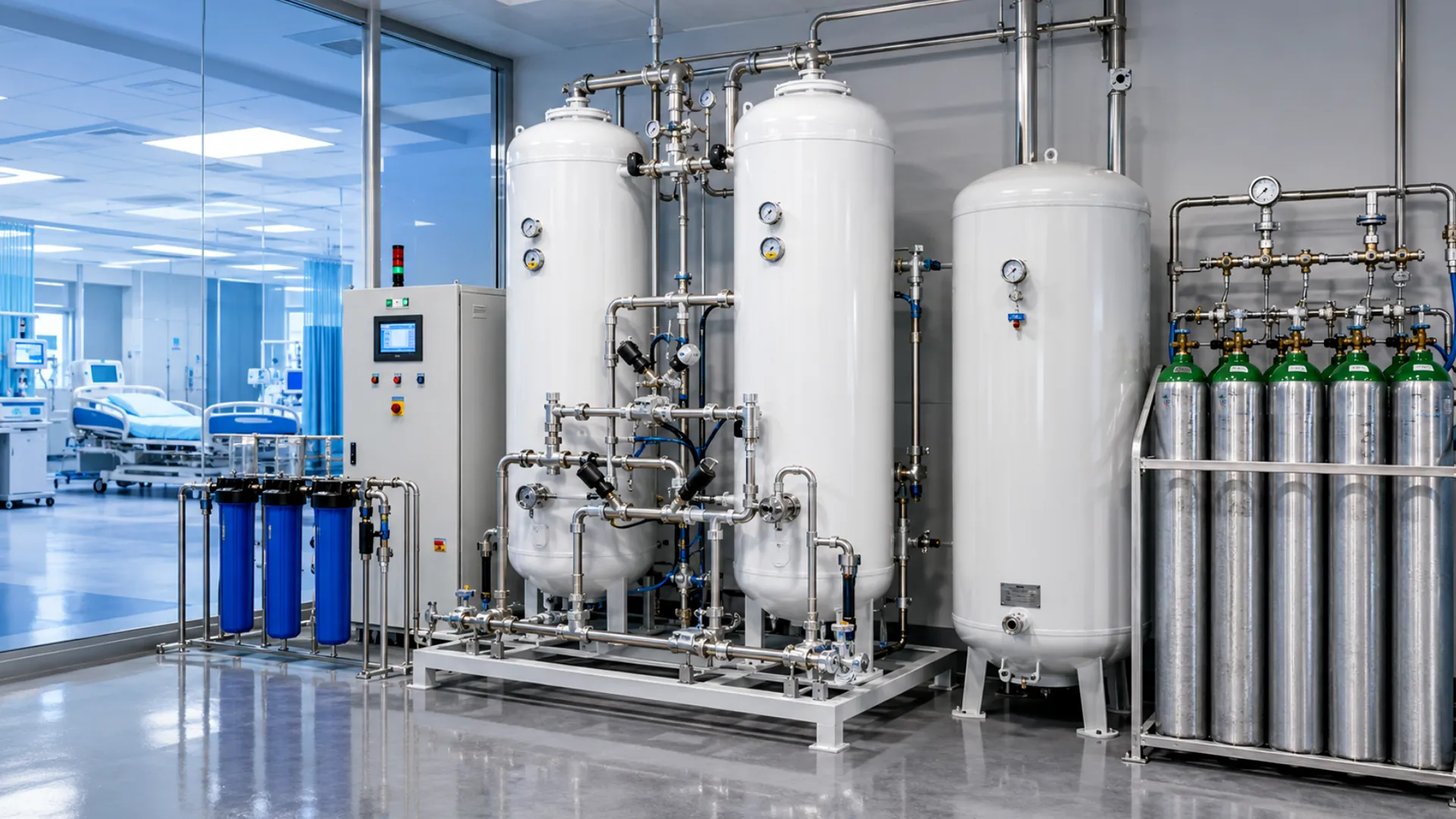
The main components of a PSA Oxygen Cylinder System include an oxygen generator, air compressor, filter unit, oxygen storage tanks, cylinder filling manifold, and oxygen cylinders. The system works through PSA Oxygen Technology, whereby oxygen is separated from atmospheric air to produce Medical Grade Oxygen whose purity normally lies between 90%-95%.
PSA Oxygen Cylinder is used for storing the oxygen which is obtained from PSA Oxygen Generator. After filling these cylinders with oxygen, they are connected to oxygen regulators, flowmeters, ventilators, anesthesia equipment, and medical gas piping.
The process is very easy and involves:
This will ensure constant availability of oxygen especially during emergencies and lack of pipeline oxygen.
Some advantages are:
Oxygen Availability on a Continuous Basis
A PSA Oxygen Cylinder System allows you to refill cylinders at your site, guaranteeing that oxygen will always be there whenever it is required.
Medical Grade Oxygen of Quality
It provides Medical Grade Oxygen which can be used in hospitals, emergency services, and healthcare centers.
Reduced Operating Expenses
On-site oxygen production saves money on the repeated expenses involved in buying, transporting, and refilling the cylinders by outside vendors.
Emergency Supply
Filling Medical Oxygen Cylinders serves as a source of emergency supply in cases of a power failure or maintenance of the central oxygen supply system.
Transportable
Oxygen cylinders can easily be transported to various locations and even to remote healthcare centers or ambulances.
Safe Storage
Modern oxygen cylinders are made from high-quality material and are subjected to pressure tests to ensure their safety in the transport and storage of oxygen.
Low Maintenance Cost
Very low maintenance is needed for PSA oxygen cylinder systems if proper inspection and handling are done.
Environmental Friendly
Producing oxygen on-site reduces the number of transports hence saves fuel and reduces emission.
Oxygen Availability on a Continuous Basis
A PSA Oxygen Cylinder System allows you to refill cylinders at your site, guaranteeing that oxygen will always be there whenever it is required.
Medical Grade Oxygen of Quality
It provides Medical Grade Oxygen which can be used in hospitals, emergency services, and healthcare centers.
Reduced Operating Expenses
On-site oxygen production saves money on the repeated expenses involved in buying, transporting, and refilling the cylinders by outside vendors.
Emergency Supply
Filling Medical Oxygen Cylinders serves as a source of emergency supply in cases of a power failure or maintenance of the central oxygen supply system.
Transportable
Oxygen cylinders can easily be transported to various locations and even to remote healthcare centers or ambulances.
Safe Storage
Modern cylinders are made of high-quality materials and undergo pressure tests, ensuring safety of storage and transportation of oxygen.
Minimal Maintenance
PSA oxygen cylinder systems require little maintenance, provided regular inspections and correct handling are ensured.
Environmentally Friendly
On-site oxygen production helps reduce transportations thus saving fuel and reducing emissions.
Did you know? A PSA Oxygen Cylinder System can refill oxygen cylinders on-site, ensuring a continuous oxygen supply without depending entirely on external gas suppliers.
Possible Reasons
Solutions
Causes
Fixing
Possible Reasons
Solutions
Causes
Solution
Possible Causes
Solution
Causes
Solution
|
Specification |
Details |
|
Product Name |
PSA Oxygen Cylinder |
|
Product Type |
Medical Oxygen Storage Cylinder |
|
Technology |
Pressure Swing Adsorption (PSA) Compatible |
|
Oxygen Purity |
90–95% (Generated by PSA System) |
|
Cylinder Material |
High-Strength Seamless Steel / Aluminum Alloy |
|
Working Pressure |
Up to 150–200 Bar |
|
Water Capacity |
10L, 20L, 40L, 47L, 50L (Model Dependent) |
|
Gas Type |
Medical Grade Oxygen |
|
Cylinder Color |
As per Local/International Standards |
|
Valve Type |
Medical Oxygen Cylinder Valve |
|
Filling Method |
PSA Oxygen Cylinder Filling System |
|
Connection Type |
Standard Medical Gas Connection |
|
Safety Features |
Pressure Tested, Leak Tested, Safety Valve |
|
Operating Temperature |
-20°C to +60°C (Typical) |
|
Compliance |
Manufactured as per Applicable Medical & Industrial Standards |
|
Refillable |
Yes |
|
Mobility |
Portable and Easy to Transport |
|
Applications |
Hospitals, Ambulances, Clinics, Laboratories, Industrial Facilities |
|
Maintenance |
Periodic Inspection, Hydro Testing & Valve Servicing |
Did you know? A PSA Oxygen Cylinder is specially designed to safely store Medical Grade Oxygen generated by a PSA oxygen generation system.
Proper maintenance of PSA Oxygen Cylinder helps in proper use and durability of the equipment. Proper maintenance will also prevent leakage, pressure loss, and breaking down.
Check the status of the cylinder before using it and see if it has any kind of damage like dents, rust, cracks, etc.
Check the level of gas in the cylinder with the help of the gauge.
Check any leakage from the valve, regulator, and connections using leakage detection solution. Leakage can not be detected by using open flames.
Check that the cylinder valve does not have any dirt, dust, oil or grease
Oxygen cylinders must be handled carefully when being transported and stored upright by means of cylinder trolleys or similar storage arrangements.
The cylinders should be stored in a place which is well ventilated and dry without direct sunlight or heat sources.
Did you know? Inspecting a PSA Oxygen Cylinder before every use helps identify dents, corrosion, cracks, or other damage that could affect safety and performance.
Airox Technologies Limited is an esteemed company providing PSA Oxygen Generators and medical oxygen solutions to the healthcare sector of India for over 13 years now. Being the leading provider of our services with 55% market share (Fiscal 2022) and installation rate of 1,100+, we are proud to provide our solutions to the government & corporate hospitals of India. Our corporate office is based in Chhatrapati Sambhajinagar and the manufacturing plant in Shendra MIDC and our branch offices are in Delhi & Kolkata. Our quality assurance is ISO 13485:2016 accredited with a national sales force and 75+ service engineers.
PSA Oxygen Cylinder has an important role to play in providing a safe, effective and continuous supply of oxygen to hospitals, health care units, laboratories and industries. In association with PSA Oxygen Cylinder System, it helps in generating oxygen at site, minimizes reliance on outside sources for oxygen and offers a cost-effective method for storage and transportation of Medical Oxygen. Knowing the definition of PSA Oxygen Cylinder, its working principle, advantages, uses and maintenance ensures that you make a correct choice of oxygen technology for your requirement. Airox Technologies Limited is dedicated to offering advanced technologies of oxygen generation, efficient equipment and technical services.